
Introduction
Buying a home is one of the most exciting milestones in life — but it also comes with new financial responsibilities. Two of the most common (and often misunderstood) terms for new homeowners are home insurance and mortgage insurance. While they sound similar, they serve completely different purposes.
This comprehensive guide explains the key differences between the two, what each covers, who needs them, and how they protect both you and your lender.
What Is Home Insurance?
Home insurance, or homeowners insurance, is designed to protect you — the homeowner — from financial losses caused by damage, theft, or liability claims. It covers both your property and your personal belongings.
What Home Insurance Covers
- Dwelling Coverage: Pays for repairing or rebuilding your home if it’s damaged by fire, storms, or vandalism.
- Other Structures: Covers detached structures such as garages, sheds, or fences.
- Personal Property: Reimburses you for the loss or damage of items like furniture, clothing, or electronics.
- Liability Coverage: Protects you if someone is injured on your property or if you accidentally damage someone else’s property.
- Loss of Use (Additional Living Expenses): Covers temporary housing and living expenses if your home becomes uninhabitable after a covered event.
What Home Insurance Doesn’t Cover
- Floods (requires a separate flood insurance policy).
- Earthquakes (usually requires an add-on).
- Normal wear and tear.
- Pest or termite damage.
In short, home insurance protects your home and finances against unexpected disasters.
What Is Mortgage Insurance?
Mortgage insurance, on the other hand, is designed to protect your lender — not you. It ensures the lender is repaid if you default on your mortgage payments. In most cases, you’ll need mortgage insurance if your down payment is less than 20% of the home’s value.
Types of Mortgage Insurance
-
Private Mortgage Insurance (PMI)
- Required for conventional loans with a down payment under 20%.
- Protects the lender if you default on your loan.
- Can be canceled once your loan-to-value (LTV) ratio reaches 80%.
- Cost: about 0.3%–1.5% of your original loan amount per year.
-
FHA Mortgage Insurance Premium (MIP)
- For FHA loans backed by the Federal Housing Administration.
- Requires an upfront premium (1.75% of loan) and **annual premiums** (0.45%–1.05%).
- Cannot be easily canceled; typically lasts for the life of the loan.
-
VA and USDA Mortgage Fees
- VA loans (for veterans) include a one-time funding fee.
- USDA loans require both an upfront and annual fee, similar to PMI.
What Mortgage Insurance Doesn’t Cover
- Your home or belongings.
- Missed payments due to job loss or illness.
- Damage to your property.
Essentially, mortgage insurance only benefits the lender, not the homeowner.
Key Differences Between Home Insurance and Mortgage Insurance
| Feature | Home Insurance | Mortgage Insurance |
|---|---|---|
|
Who It Protects |
The homeowner |
The lender |
|
What It Covers |
Property damage, theft, liability |
Default on mortgage payments |
|
Who Requires It |
Homeowner (or lender as loan condition) |
Lender (if down payment < 20%) |
|
Who Pays For It |
Homeowner |
Homeowner |
|
Can It Be Canceled? |
Yes, anytime |
Yes, when equity reaches 20% |
|
Average Annual Cost |
$1,500–$2,000 |
0.3%–1.5% of loan value |
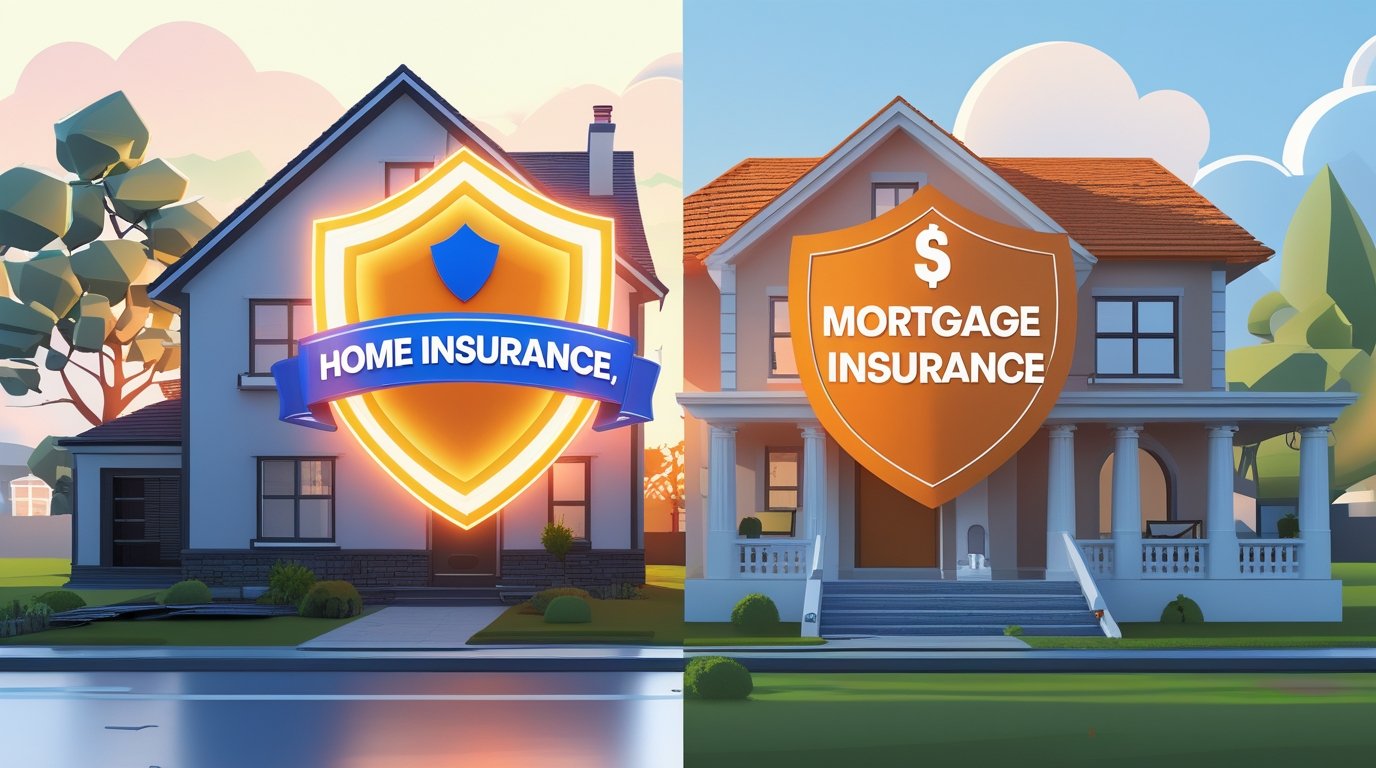
🏠 Home insurance protects your property.
🏦 Mortgage insurance protects your lender.
Why Lenders Require Both?
Mortgage lenders require both types of insurance under certain conditions:
- Home insurance ensures that if the home is damaged, it can be repaired or rebuilt (protecting the lender’s collateral).
- Mortgage insurance ensures the lender still gets paid if you stop making payments.
Both help reduce financial risk for everyone involved.
Can You Have One Without the Other?
Yes — depending on your circumstances:
- You can have home insurance without mortgage insurance if you make a large down payment (20% or more).
- You can’t have mortgage insurance without home insurance if you’re financing your home, since the lender requires home insurance for protection.
Once your loan is paid off, you can cancel mortgage insurance, but keeping home insurance is strongly recommended.
How to Remove or Avoid Mortgage Insurance
Mortgage insurance can be expensive, but it’s not forever. Here’s how to eliminate it:
- Make a Larger Down Payment: Put down at least 20% to avoid PMI.
- Refinance Your Mortgage: Once your home equity reaches 20%, refinance to remove PMI or switch to a conventional loan.
- Request PMI Cancellation: Under the Homeowners Protection Act, you can request PMI removal when your loan balance reaches 80% of your home’s original value.
- Pay Down Your Loan Faster: Making extra payments helps you reach the equity threshold sooner.
Example
If you buy a $300,000 home with a 10% down payment, your loan balance is $270,000. Once you’ve paid off enough to bring your balance below $240,000 (80%), you can request to cancel PMI.
Cost Comparison: Home Insurance vs. Mortgage Insurance
| Coverage Type | Average Annual Cost | Who It Protects | Duration |
|---|---|---|
|
Home Insurance |
$1,500–$2,000 |
Homeowner | Ongoing |
|
Mortgage Insurance (PMI) |
0.3%–1.5% of loan |
Lender | Until 20% equity |
|
FHA MIP |
0.45%–1.05% + 1.75% upfront |
Life of loan (<10% down) |
Mortgage insurance may feel unnecessary, but it enables many Americans to become homeowners sooner, even with smaller down payments.
Why Home Insurance Is Essential
Even if your mortgage is fully paid off, home insurance is still vital. It protects your home — your biggest investment — from costly disasters and liability claims.
Benefits of Home Insurance
- Covers rebuild or repair costs after disasters.
- Replaces stolen or damaged personal items.
- Offers liability protection for accidents.
- Provides peace of mind for unexpected events.
Without it, you could face tens or hundreds of thousands in losses after a fire or storm.
Common Myths About Home and Mortgage Insurance
- Myth 1: “Mortgage insurance protects my home.”
❌ False. It protects your lender, not your house. - Myth 2: “I can’t cancel PMI.”
❌ You can request cancellation once your loan balance drops below 80% of your home’s original value. - Myth 3:“Home insurance is optional.”
⚠️ Not for mortgage holders — lenders require it, and even without a loan, it’s essential protection. - Myth 4:“Both cover similar things.”
❌ Completely false. They serve entirely different purposes.
How to Save on Both?
Saving on Home Insurance
- Bundle your home and auto insurance.
- Raise your deductible.
- Install home security systems.
- Maintain a good credit score.
Saving on Mortgage Insurance
- Put down 20% or more.
- Refinance when your equity grows.
- Monitor your home’s value and request PMI cancellation early.
Conclusion
While they share similar names, home insurance and mortgage insurance protect very different things.
🏠 Home insurance protects your property, belongings, and financial well-being.
🏦 Mortgage insurance protects your lender and helps you qualify for a mortgage with a smaller down payment.
Think of it this way: mortgage insurance helps you get into a home, and home insurance helps you keep it safe.
Together, they ensure that your dream of homeownership stays protected — no matter what life brings.